


News & Projects

The importance of air treatment in compressed air systems
Compressed air is an important utility for many manufacturing and industrial processes, but alongside the need for compressed air is consideration of the degree of air purity required and how to achieve this.
CONTAMINANTS IN COMPRESSED AIR
The air produced by compressors inherently contains contaminants unless treated. These typically consist of:
- Moisture – from the atmosphere. This enters the piping system from ambient air via the intake and makes up all of the liquid contamination found.
- Dust and dirt – particles present in the air and surrounding environment.
‘An industrial environment can contain more than 140 million dirt particles per cubic metre.’ - Micro-organisms – e.g. bacteria. These microscopic entities are minute and pass through the compressor’s inlet filter.
- Oil – from oil-lubricated compressors may come from the ambient sources such as vehicle and industrial emissions.
THE IMPACT OF CONTAMINANTS
Though barely visible, if at all, these contaminants pose a threat to your compressor system, pipework and associated equipment, production processes and end products.
Water vapour can lead to bacterial growth which can impact the final quality of some end processes. This is particularly important for food and beverage applications and pharmaceutical manufacture where air purity is of the highest importance and failure could result in physical harm to the end users.
Where dust and dirt are concerned, particles can be so small as to pass through an inlet filter. Under pressure, the impact of these particles is multiplied. Likewise, micro-organisms, including bacteria, are not entirely filtered during intake. Smaller micro-organisms can get through and require further treatment after air compression. They can present a serious problem in many industries as they can multiply under certain conditions and thrive in the moist air delivered after compression. Micro-organisms are a potential risk for food, beverage and pharmaceutical manufacture, where sterile air is vital.
Oil contamination results when minute quantities of oil escape from oil-injected compressors. Although this is generally the lowest level of contaminant, it can nevertheless be detrimental to end products.

OUTCOMES OF CONTAMINATION
Each of the above pollutants can cause harm in the following ways either individually or collectively:
- They can damage equipment over time leading to rusting and corrosion in pneumatic tools, valves and cylinders – in fact, any element involved in the air compressor system.
- This leads to increased maintenance and potential downtime.
- Impairment of equipment then affects performance and efficiency.
- Impure air impacts upon the quality and safety of the end products, e.g. blisters in paint spraying systems.
- This can result in customer dissatisfaction, rejection and return of products – not desirable for any business.

AIR TREATMENT
Air treatment is critically important to ensure the quality, purity and safety of compressed air. The aim is to produce clean, dry air to the standard required by the end user and as defined by ISO air quality standards (ISO 8573-1).
N.B. The ISO air quality standard measures three types of contaminants present in compressed air: water, oil content and solid particles. It does not consider microorganisms and gases.
Air filters
Air filters play a crucial role in ensuring the quality of compressed air by capturing dust, dirt, rust, and other particulates from the ambient air before it enters the compressor or just after compression. However, the effectiveness of air filters can vary based on environmental and operating conditions. At higher temperatures, filters may struggle to remove moisture because water stays in vapour form, and some filter materials may not perform well. If there’s too much oil or water, filters can become overloaded and stop working properly. To keep filters effective, it’s important to stay within their design limits or use additional equipment like dryers or pre-filters when needed.
The first step is to identify which contaminants are to be removed and then select an appropriate filter – this will depend upon the level of purity required. Filters can be placed at multiple points along the system to extract different contaminants at each stage. However, filters can only remove so much and further methods are required for removing moisture.
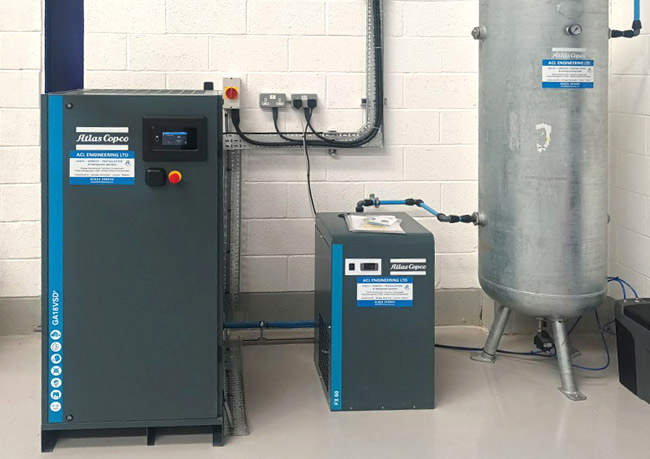
Air Dryers
Moisture can have wide-ranging and damaging effects on air compressor systems and the end products created. Drying is therefore of the utmost importance, and there are various methods available relative to budget and dew point.
(The dew point refers to the temperature at which water vapor in the compressed air will condense into liquid water. This temperature is measured at a specific pressure, known as the pressure dew point (PDP). A lower PDP indicates less moisture in the compressed air).
- Refrigerant dryers – Heat exchangers remove moisture through condensation. They work by cooling the air down via a refrigerant-to-air heat exchanger, which condenses the moisture from the air, and then re-heating the air to prevent moisture re-forming. Refrigerant dryers in air compressor systems typically achieve dew point levels between +2°C and +10°C.
- Desiccant dryers adsorb moisture from the compressed air. As the air flows over hygroscopic material, water vapour is drawn into it until it becomes saturated – at which point it requires ‘regeneration’ to regain its drying capacity. A two-vessel system ensures that one vessel is adsorbing whilst the other is regenerating and then the two swap roles. Desiccant dryers can achieve very low dew point levels, typically ranging from -20°C to -70°C.
- Membrane dryers – Simple to operate, silent, with low power usage and minimal service requirements, they use a process of selective permeation of the gas components in the air. Hollow polymer fibres within a cylinder remove water vapour as compressed air flows over them. The water is then vented outside the cylinder. Membrane dryers achieve -32°C Pressure Dewpoint Suppression and -55°C Pressure Dewpoint Suppression.
CONDENSATE TREATMENTS
Once the moisture has been extracted from the compressed air, the oil and water liquid byproduct must be disposed of safely. The oil and water need to be separated to meet standards and environmental prevent damage. This is achieved through a further series of precision filters including polypropylene and activated carbon, followed by organoclay for more concentrated fluids. This will reduce the residual oil content to >10ppm to comply with regulations.
CLEAN, DRY AIR
So, whilst compressed air is an important commodity that can be put to many different specialised uses, it does require careful treatment and care to ensure that the output is of the purity required. Filtration, drying and condensate treatments should therefore be considered an integral part of any air compressor system.
For optimum filtration and air quality, contact ACL Engineering for further details call 01923 249444 or email infoacl@aclengineering.co.uk

ASK US ABOUT THE IMPORTANCE OF AIR TREATMENT IN COMPRESSED AIR SYSTEMS